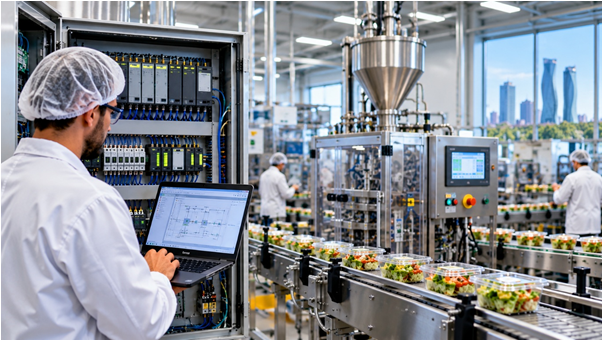
Manufacturing plants in Mississauga rely on automated equipment to keep production moving. In food processing, packaging and process manufacturing, even a small control issue can stop a machine, slow a production line or affect product quality.
A well programmed PLC can make a major difference.
PLC programming services can help manufacturers improve machine control, make faults easier to find, improve communication between equipment and support upgrades to older automation systems.
For plants where production depends on pumps, motors, conveyors, sensors, valves, filling equipment, packaging machines and process controls, reliable PLC programming is an important part of keeping operations running smoothly.
Why PLC Programming Matters in Food and Process Manufacturing
Food and process manufacturing often involves several machines working together. A problem with one part of the process can affect everything that comes after it.
For example, a packaging line may depend on product detection, conveyor movement, filling, sealing, labelling and inspection. If the PLC does not handle these steps correctly, the line may stop or produce inconsistent results.
A properly programmed PLC controls the sequence of operations and helps equipment respond to changing conditions.
It can manage:
- Machine start and stop sequences
- Sensors and switches
- Motors and drives
- Pumps and valves
- Temperature and pressure controls
- Product detection
- Alarms and fault conditions
- Safety interlocks
- Communication between machines
- Operator commands through an HMI
For Mississauga manufacturers, this means the PLC becomes an important part of daily production, not simply a piece of automation hardware.
PLC Programming for Food Manufacturing Plants
Food manufacturing requires consistent process control. Production equipment needs to operate in the correct sequence while maintaining the required process conditions.
PLC programming can support equipment such as mixers, pumps, conveyors, filling machines, packaging equipment, temperature control systems and other automated machinery.
For example, a PLC can monitor temperature sensors and control heating equipment. It can also operate pumps and valves according to a programmed sequence.
If a temperature moves outside the required range, the system can trigger an alarm and take the required control action.
This type of automation can help operators respond to problems faster and reduce unnecessary interruptions to production.
Good PLC programming also makes machine behaviour easier to diagnose. Instead of simply showing that a machine has stopped, the control system can provide useful information about the condition that caused the stop.
PLC Programming for Packaging Equipment
Packaging operations depend heavily on timing and coordination.
A packaging machine may need to detect a product, position it correctly, operate a filling or sealing mechanism and send the finished product to the next stage.
Every step needs to happen at the right time.
PLC programming controls these sequences and allows different parts of the equipment to work together.
A well structured program can also manage:
- Product sensors
- Conveyor movement
- Motor and drive control
- Filling operations
- Sealing operations
- Product counting
- Machine timing
- Fault detection
- Emergency conditions
- Operator settings
When a packaging machine stops, maintenance staff need to know why. Clear PLC logic and useful HMI messages can make that troubleshooting process much faster.
PLC and HMI Programming Work Together
The PLC controls the machine, while the HMI gives operators a practical way to interact with it.
A useful HMI can show machine status, alarms, process values and operating conditions in a way that is easy to follow.
For example, instead of showing a general machine fault, the HMI can identify a specific condition such as a product sensor not detecting an item or a motor failing to reach the required operating condition.
This gives operators and maintenance teams more information at the point where they need it.
PLC programming Mississauga projects can include both PLC logic and HMI development so that the control system and operator interface work together properly.
PLC System Integration in Mississauga
Modern manufacturing equipment rarely works as one isolated machine.
A production area may include PLCs, HMIs, drives, robots, sensors, control panels and other industrial equipment. These systems need to communicate correctly.
PLC system integration helps connect these different parts of the operation.
Industrial communication can allow a PLC to exchange information with:
- HMIs
- Variable frequency drives
- Remote I/O
- Sensors and instruments
- Other PLCs
- SCADA systems
- Production equipment
- Industrial networks
Good communication is important for both machine operation and troubleshooting. A communication problem can stop production just as quickly as a mechanical problem.
Troubleshooting PLC Problems Before They Cause Bigger Delays
Not every production problem requires a complete equipment replacement.
Sometimes the issue is inside the control logic, an input or output, a communication connection, a sensor or an incorrect sequence.
PLC troubleshooting can help identify the actual cause.
A technical review may look at:
- The current PLC program
- Input and output conditions
- Machine sequences
- Alarm history
- HMI messages
- Communication status
- Sensors and field devices
- Interlocks and permissives
- Drives and motor conditions
- Changes made to the system
The goal is to find the source of the problem rather than repeatedly resetting the machine and hoping it runs again.
For production facilities, faster fault diagnosis can mean less lost production time.
Supporting Older PLC Systems
Many Mississauga manufacturing plants have automation systems that have been operating for years.
Older PLC systems can continue to provide reliable service, but they may become harder to maintain as hardware becomes obsolete or programming knowledge becomes less available.
A PLC review can identify issues before they become serious.
This may include:
- Reviewing the existing PLC program
- Checking available program backups
- Reviewing hardware condition
- Identifying obsolete components
- Checking communication systems
- Improving alarm information
- Planning PLC migration
- Updating HMI screens
- Documenting existing control logic
A planned upgrade is often easier to manage than an emergency replacement after an important control component fails.
PLC Programming for Process Manufacturing
Process manufacturing depends on controlled movement and treatment of materials.
Applications can include pumps, tanks, valves, mixers, temperature systems, flow control and other process equipment.
PLC programming can manage these operations using defined sequences and control conditions.
For example, a process may require a valve to open only after a tank reaches a specific level. A pump may need to start only after another condition has been confirmed.
These conditions can be built into the PLC program using interlocks and control logic.
The result is a more controlled process with fewer opportunities for incorrect machine operation.
A Practical PLC Programming Process
Good PLC programming starts with the actual machine and its operating requirements.
A typical project can involve the following steps:
- Review the Existing System
The first step is to look at the current equipment, PLC hardware, HMI, I/O and communication setup.
For an existing machine, the current PLC program and available backups should also be reviewed.
- Identify the Control Requirements
The required machine sequence needs to be clear.
This includes normal operation, start and stop conditions, faults, alarms, interlocks and recovery steps.
- Develop or Modify the PLC Program
The PLC logic is then developed or modified based on the required operation.
The work may involve new programming, changes to existing logic or improvements to an older control system.
- Test the Logic
The program should be tested before production use whenever possible.
Normal operation and fault conditions should both be considered.
- Commission the System
The programmed system is checked with the actual equipment, sensors, drives and other connected devices.
Any required adjustments can then be made.
- Document the Changes
Updated PLC programs, HMI files and related control information should be properly saved and documented.
This gives maintenance teams a useful reference for future troubleshooting and system changes.
Industries Supported by PLC Programming in Mississauga
Mississauga has a strong base of manufacturing and industrial operations that depend on automation.
PLC programming can support applications across areas such as:
- Food and beverage manufacturing
- Packaging
- Process manufacturing
- Automotive manufacturing
- Industrial equipment
- Material handling
- Warehousing
- Plastics
- Fabricated products
- Pharmaceutical and life sciences manufacturing
Each application has different control requirements.
A packaging machine has different needs from a process system with pumps and valves. A conveyor system also requires a different control sequence from a food processing system.
The PLC program needs to reflect the way the equipment actually operates.
When Should a Mississauga Plant Review Its PLC Program?
A PLC review can be useful when a plant starts experiencing repeated control problems.
Some common signs include:
- Frequent machine stoppages
- Difficult fault diagnosis
- Old or missing PLC backups
- Unclear HMI alarm messages
- Repeated manual resets
- Slow machine sequences
- Communication problems
- Obsolete PLC hardware
- Production equipment upgrades
- New equipment being added to an existing line
- Changes in the manufacturing process
These issues do not always mean the entire automation system needs to be replaced.
In many cases, reviewing and improving the existing PLC program can be a practical starting point.
Why Local PLC Support Matters
Manufacturing problems do not always happen during convenient hours.
A production issue can affect operators, maintenance teams, production schedules and delivery commitments.
Having access to PLC programming and technical support in the Mississauga area can make it easier to assess control problems, modify existing programs and support automation projects.
ControlSoft Canada provides PLC programming and control engineering support for industrial applications in Mississauga and the surrounding GTA.
The work can cover PLC programming, HMI development, PLC troubleshooting, system integration, control system upgrades and industrial communication.
Reliable PLC Programming Supports Reliable Production
For food, packaging and process manufacturing plants, PLC programming is closely connected to everyday production.
The PLC controls machine sequences, receives information from field devices, communicates with other equipment and helps operators manage the process.
When the control logic is clear and properly maintained, maintenance teams can diagnose problems more easily and operators can get better information from the system.
That can make a real difference when production depends on keeping automated equipment running.
If your Mississauga facility needs a new PLC application, an existing program modification, troubleshooting support or an upgrade for an older control system, PLC programming can provide the technical foundation needed to keep your automation moving with confidence.