

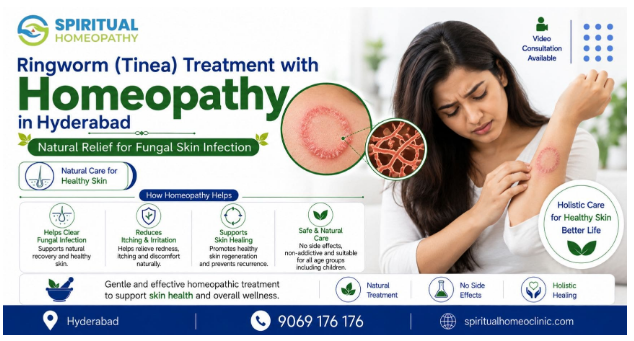
Dealing with red, itchy, ring-shaped skin patches can cause constant physical discomfort and emotional self-consciousness. Exploring Ringworm Treatment with Homeopathy offers individuals in Hyderabad a natural, constitutional approach aimed at soothing skin irritation, addressing internal susceptibility, and supporting long-term skin vitality alongside standard medical evaluations. Understanding how complementary holistic care fits into a complete skin management plan helps patients handle fungal skin infections with confidence and clarity.
At Spiritual Homeopathy, a recognized healthcare clinic in Hyderabad, our compassionate doctors focus on providing individualized, patient-centered care for both acute and chronic conditions. Operating as a non-profit organization dedicated to accessible healthcare, Spiritual Homeopathy provides tailored clinical evaluations for women’s health, skin and hair concerns, hormonal imbalances, digestive disorders, child healthcare, and other chronic health issues. Our experienced homeopaths focus on understanding every patient’s complete physical profile to guide them toward healthy skin and lasting recovery.
What Is Ringworm and Why Is It Called a Fungal Infection?
What Is Ringworm?
Ringworm is a common, highly contagious superficial skin infection characterized by raised, circular, ring-like patches on the outer layers of the skin. Global epidemiological studies published by the World Health Organization (WHO) highlight that fungal skin infections affect over 20% of the global population, thriving particularly in tropical and humid climates.
Why Ringworm Is Not Caused by a Worm
Despite its misleading historical name, ringworm has nothing to do with parasitic worms. The term originated centuries ago because the raised, red borders of the circular skin rash resemble a small worm coiled beneath the skin.
Understanding Tinea and Dermatophyte Fungi
The medical term for ringworm is tinea, caused by microscopic fungi known as dermatophytes. These specialized organisms—predominantly species of Trichophyton, Microsporum, and Epidermophyton—feed on keratin, a tough protective protein found in human skin, hair, and nails.
How Fungi Affect the Skin
Dermatophyte fungi colonize the outer stratum corneum layer of the epidermis. As the fungal colony grows outward in a circular pattern, it triggers localized inflammation, scaling, redness, and intense itching.
Why Ringworm Can Appear on Different Parts of the Body
Because keratin is present across the entire body surface, dermatophyte fungi can infect virtually any region, from the scalp, face, and trunk to the groin folds, feet, and fingernails.
Common Signs and Symptoms of Ringworm
Circular or Ring-Shaped Skin Rash
The hallmark feature is a distinct, ring-like lesion with raised, reddish outer edges and a slightly elevated border.
Itching and Skin Irritation
Persistent, intense itching (pruritus) is often the most distressing symptom, frequently worsening in warm conditions or after sweating.
Red, Scaly or Dry Skin
The affected skin tissue often appears inflamed, flaky, dry, or covered with fine silvery scales along the active perimeter.
Gradually Expanding Rash
As the microscopic fungi propagate, the outer red border slowly expands outward across healthy skin tissue over days or weeks.
Clearer Skin in the Center of Some Lesions
As the active border migrates outward, the center of the ring-shaped lesion may show signs of healing, appearing lighter, smoother, or less inflamed.
How Symptoms Can Differ Depending on the Affected Body Area
- Body (Tinea Corporis): Classic expanding circular rings with clear centers.
- Groin (Tinea Cruris): Intense itching and red-brown chafed borders along inner thighs.
- Feet (Tinea Pedis): Cracking, peeling skin, and burning discomfort between toes.
- Scalp (Tinea Capitis): Scaly patches, fragile hair breaking at the root, and localized hair loss.
How Does Ringworm Spread From One Person to Another?
Key Transmission Pathways of Ringworm
- Direct Skin-to-Skin Contact: Skin-to-skin touch with an infected individual during daily interactions, sports, or close physical contact.
- Sharing Personal Items: Indirect transfer by sharing towels, hair combs, bed sheets, clothing, or athletic equipment carrying active spores.
- Contact With Infected Animals: Touching household pets like kittens, puppies, or livestock that carry dermatophyte fungi on their fur.
- Contaminated Shared Surfaces: Walking barefoot or sitting on damp public surfaces such as locker room floors, swimming pool decks, or gym mats.
Direct Skin-to-Skin Contact
The primary mode of transmission is direct physical contact with active ringworm lesions on an infected individual during sports, hugging, or close daily interactions.
Sharing Towels, Clothes and Personal Items
Fungal spores survive on inanimate objects (fomites). Sharing bath towels, bed sheets, combs, clothing, or athletic gear readily transfers fungal spores.
Contact With Infected Animals
Household pets, particularly kittens, puppies, and farm livestock, frequently harbor dermatophyte fungi on their fur without showing obvious hair loss.
Contaminated Surfaces and Shared Spaces
Damp public surfaces—such as locker room floors, swimming pool decks, public showers, and gym mats—provide ideal grounds for fungal spores.
Why Warm and Moist Environments Can Encourage Fungal Growth
Dermatophytes thrive in dark, warm, and humid environments. Excessive sweating, tight synthetic clothing, and humid weather in regions like Hyderabad accelerate fungal germination.
Different Types and Locations of Tinea Infection
Tinea Corporis – Ringworm of the Body
Appears on arms, legs, chest, or back as classic ring-shaped lesions with raised, scaly borders.
Tinea Cruris – Fungal Infection Around the Groin
Commonly known as “jock itch,” this variant affects the inner thighs, groin, and buttocks, thriving in warm, damp body folds.
Tinea Pedis – Athlete’s Foot
Infects the skin between the toes and the soles of the feet, causing scaling, painful skin fissures, and intense burning.
Tinea Capitis – Ringworm of the Scalp
Involves hair follicles on the scalp, causing flaky patches, broken hair shafts (“black dots”), localized hair loss, and occasional painful swelling.
Tinea Unguium – Fungal Infection of the Nails
Also called onychomycosis, this condition causes thickened, brittle, discolored yellow or white nails that may separate from the nail bed.
Why Location Can Influence Symptoms and Treatment
Thicker skin on the soles of the feet or keratin-dense scalp hair follicles require different care durations compared to thin skin on the torso.
Ringworm vs Other Common Skin Conditions
| Feature | Ringworm (Tinea) | Eczema (Atopic Dermatitis) | Psoriasis |
| Primary Cause | Superficial dermatophyte fungal infection. | Immune dysfunction and skin barrier breakdown. | Autoimmune acceleration of skin cell turnover. |
| Lesion Shape | Well-defined circular rings with clear centers. | Ill-defined, patchy, dry, or weeping lesions. | Well-demarcated silvery scaly plaques. |
| Active Border | Raised, scaly, reddened outer perimeter. | Irregular edges without clear central clearing. | Thick, sharp borders with silvery scaling. |
| Common Sites | Any body site, groin folds, feet, scalp. | Flexoral creases (elbows, behind knees). | Extensor surfaces (knees, elbows, lower back). |
| Contagious? | Highly contagious through contact/fomites. | Non-contagious. | Non-contagious. |
Ringworm vs Eczema
While both cause itching and redness, eczema lesions lack the distinct circular border with central clearing typical of tinea infections.
Ringworm vs Psoriasis
Psoriasis presents with thicker, silvery-white scales on raised plaques, whereas ringworm displays thinner scales concentrated along an expanding outer ring.
Ringworm vs Contact Dermatitis
Contact dermatitis follows direct exposure to an irritant or allergen (like harsh chemicals or metals), producing sudden localized burning rather than an expanding fungal ring.
Why Similar-Looking Rashes Can Have Different Causes
Inflammatory skin conditions often share superficial traits like redness, itching, and scaling, making professional evaluation essential.
Why Self-Diagnosis Can Sometimes Be Misleading
Misdiagnosing a fungal infection as eczema and applying steroid creams can suppress localized skin immunity, causing the fungal rash to spread rapidly—a clinical phenomenon known as tinea incognito.
How Ringworm Is Diagnosed
Clinical Examination of the Skin
Dermatologists and clinicians inspect the distribution, active border characteristics, and scaling patterns of the skin rash under proper lighting.
Reviewing the Appearance and Pattern of the Rash
Identifying classic ring-shaped lesions, central clearing, and active border scaling helps distinguish fungal infections from other dermatological conditions.
KOH Testing and Skin Scrapings When Needed
A microscopic Potassium Hydroxide (KOH) preparation involves gently scraping scales from the active border. KOH dissolves skin keratin, revealing branching fungal hyphae under the microscope.
Fungal Culture in Selected Cases
When microscopic testing is inconclusive, skin scrapings are cultured in a specialized laboratory medium to identify the exact dermatophyte species.
When Additional Testing May Be Considered
Severe scalp involvement or suspected nail involvement may require specialized dermoscopy or histological staining to evaluate deeper hair follicles or nail beds.
Why Correct Diagnosis Matters Before Choosing Treatment
Confirming a fungal cause before starting therapy prevents inappropriate skin treatments that could worsen the infection or delay recovery.
Understanding the Usual Medical Treatment for Ringworm
Role of Antifungal Treatment
Standard medical care focuses on clearing the underlying fungal organism using targeted topical or oral antifungal therapies.
Topical Treatment for Limited Skin Infections
Uncomplicated tinea on localized body skin is typically managed with topical antifungal creams, sprays, or lotions applied directly to the lesion and surrounding healthy skin.
When Oral Antifungal Treatment May Be Required
Extensive skin coverage, recurrent fungal infections, scalp ringworm (tinea capitis), or nail involvement generally require prescription oral antifungal tablets under medical supervision.
Why Treatment Duration Can Vary
Topical care usually continues for two to four weeks, whereas scalp and nail fungal infections may require several months of consistent management.
Why Stopping Treatment Too Early Can Lead to Recurrence
Discontinuing care as soon as visible redness subsides—while microscopic fungal spores remain viable—frequently causes the rash to return.
Why Scalp and Nail Infections May Need Different Management
Fungi residing deep within hair shafts or beneath thick nail plates cannot be reached by surface topical creams alone, requiring systemic care.
Understanding Ringworm Treatment with Homeopathy
What a Homeopathic Consultation May Focus On
When exploring Ringworm Treatment with Homeopathy, doctors conduct an in-depth consultation that examines the patient’s individual skin pattern, immune response, and overall health.
Understanding the Individual Skin-Symptom Pattern
Homeopathic evaluations focus on unique symptom characteristics:
- Does itching intensify at night or after taking a warm bath?
- Is the skin rash dry and scaly, or does it ooze fluid when scratched?
- Does the patient experience heightened sensitivity to hot, humid weather?
Looking at Itching, Irritation and Skin Changes
Clinicians assess the severity of skin itching, redness, inflammation, and physical discomfort to understand how the body responds to the infection.
Supportive Care Alongside Appropriate Medical Management
Homeopathy serves as a constitutional supportive option alongside standard medical hygiene practices, focusing on supporting systemic immunity and skin recovery.
Setting Realistic Expectations About Complementary Care
Holistic care works in harmony with natural healing processes to support comfortable skin, reduce itching, and promote long-term resilience.
Understanding ringworm homeopathy as Supportive Skin Care
Looking at Individual Skin Symptoms
Individualized assessments for ringworm homeopathy focus on the complete health profile of the patient rather than treating isolated skin patches.
Understanding Itching and Irritation
Monitoring how itching and skin redness respond to daily hygiene habits helps clinicians tailor supportive care recommendations.
Monitoring Changes in the Rash
Regular follow-ups track changes in border redness, scaling, and rash spread over time.
Supporting Overall Skin Care and Hygiene
Complementary approaches emphasize maintaining a clean skin environment to support natural skin barrier recovery.
Why Appropriate Antifungal Management Should Not Be Replaced
Complementary care works best as a supportive approach alongside standard medical evaluations. Active fungal infections should be managed with proper medical guidance.
Understanding tinea homeopathy and Different Fungal Infections
What the Term Tinea Means
Tinea is the medical designation for superficial fungal skin infections categorized by location (e.g., corporis, cruris, pedis, capitis).
How Tinea Can Affect Different Body Areas
Each body area presents distinct environmental conditions—from sweaty groin folds to hair-dense scalps—that influence fungal growth.
Why Scalp, Skin, Groin and Nail Infections Can Differ
Scalp and nail infections involve dense keratin structures, requiring specialized management compared to flat skin surfaces.
Importance of Identifying the Specific Type of Infection
Accurately categorizing the tinea variant ensures appropriate hygiene adjustments, personal care routines, and clinical management.
Why Treatment Should Be Based on Proper Diagnosis
Subjective symptoms like itching can stem from non-fungal causes; confirming a tinea diagnosis ensures targeted, safe care.
What to Know About homeopathic treatment for ringworm
Why Diagnosis Should Come Before Complementary Care
Before starting homeopathic treatment for ringworm, securing a formal medical diagnosis ensures that other inflammatory skin conditions are ruled out.
Understanding the Duration and Pattern of the Rash
Documenting how long the rash has persisted and whether it spreads during humid weather helps guide personalized care plans.
Monitoring Itching, Scaling and Spread
Tracking symptom changes provides objective feedback on overall skin health and healing progress.
Individualized Assessment of Skin Concerns
Homeopathic practitioners consider constitutional factors, lifestyle habits, and personal medical history when designing supportive care plans.
Why Homeopathy Should Not Be Presented as a Replacement for Antifungal Treatment
Complementary care is designed to support the body’s natural recovery processes alongside established medical protocols, not replace necessary antifungal therapy.
Understanding fungal infection homeopathy and Skin Health
Why Fungal Infections Can Recur
Recurrent fungal skin issues often occur due to incomplete initial treatment, persistent skin moisture, lowered immune resilience, or re-exposure to contaminated environments.
Recognizing Persistent or Repeated Skin Changes
Identifying why ringworm recurs—such as wearing damp clothes or shared sports equipment—helps prevent ongoing cycles of infection.
Importance of Keeping the Skin Clean and Dry
Fungi require moisture to propagate. Maintaining dry, clean skin folds is an essential step in controlling fungal growth.
Monitoring Changes During Recovery
Observing reduced border scaling, diminished itching, and healthy skin regeneration signals positive recovery progress.
When Persistent Fungal Symptoms Need Re-Evaluation
Fungal skin rashes that fail to clear or continue expanding require re-evaluation by a dermatologist to check for treatment resistance or underlying health factors.
Hygiene and Lifestyle Habits That Can Help Prevent Ringworm
| Category | Recommended Daily Practice | Key Prevention Benefit |
| Personal Hygiene | Wash skin daily with mild soap and dry skin folds thoroughly. | Eliminates excess moisture required for fungal germination. |
| Clothing Choices | Change out of sweaty clothing immediately; wear loose cotton garments. | Keeps body folds cool and prevents friction/chafing. |
| Personal Belongings | Never share towels, combs, razors, or athletic gear. | Prevents indirect fungal spore transmission (fomites). |
| Laundry Routine | Wash towels and bedding regularly in warm water with detergent. | Kills microscopic fungal spores trapped in fabrics. |
| Public Safety | Wear waterproof sandals in public showers, pools, and gym locker rooms. | Shields feet from contact with contaminated wet surfaces. |
| Pet Care | Have household pets inspected by a vet if hair loss is noticed. | Prevents continuous animal-to-human fungal reinfection. |
Keeping Skin Clean and Dry
Gently wash skin daily with mild soap and thoroughly dry all body folds—especially the groin, armpits, and between toes—before dressing.
Changing Sweaty Clothes Regularly
Promptly change out of workout gear, damp clothes, or sweaty socks after physical activity or commuting in humid weather.
Avoiding Shared Towels and Personal Items
Never share bath towels, hairbrushes, caps, athletic clothing, or footwear with others.
Washing Clothes and Bedding Properly
Launder bath towels, gym attire, and bed sheets regularly using warm water and detergent to eliminate residual fungal spores.
Wearing Appropriate Footwear in Shared Wet Areas
Always wear waterproof sandals or flip-flops when using public swimming pools, gym showers, and shared locker facilities.
Checking Household Pets When Infection Is Recurrent
Inspect household dogs and cats for scaly patches, unhealed scratches, or hair loss, and consult a veterinarian if symptoms appear.
Avoiding Scratching and Further Skin Irritation
Keep fingernails short and clean to avoid breaking the skin barrier while scratching, which can introduce secondary bacterial infections.
Why Ringworm Can Come Back After It Appears to Improve
Incomplete Treatment
Stopping topical application as soon as itching stops allows surviving fungal spores beneath the surface to grow back.
Reinfection From Close Contacts
Untreated family members, romantic partners, or sports teammates with mild fungal rashes can continually pass the infection back and forth.
Continued Exposure to Moist or Contaminated Environments
Working in humid environments without changing wet clothes maintains conditions that encourage fungal growth.
Infection From Household Items or Pets
Contaminated couch fabrics, car seat covers, or undiagnosed pet skin conditions can serve as ongoing sources of reinfection.
Why Recurring Ringworm May Need Reassessment
Repeated fungal outbreaks warrant clinical review to evaluate skin immunity, rule out underlying conditions like diabetes, and confirm fungal strain sensitivities.
Why Repeated Self-Treatment Can Delay the Correct Diagnosis
Relying on over-the-counter mixed creams containing strong steroids can temporarily hide symptoms while allowing the underlying fungal infection to spread deeper.
When Ringworm Symptoms Require Medical Attention
Key Warning Signs Requiring Prompt Professional Care
- Rapidly Spreading Rash: Ring-shaped lesions expanding quickly across multiple body areas.
- Severe Pain, Swelling or Skin Breakdown: Deep skin cracking, severe localized pain, or tissue breakdown.
- Pus, Crusting or Signs of Secondary Infection: Oozing yellow pus, thick golden crusts, or extreme warmth (indicating bacterial superinfection).
- Ringworm Affecting the Scalp: Scalp ringworm requires oral systemic care to prevent permanent hair follicle damage.
- Hair Loss Along With Scalp Lesions: Broken hair shafts or patchy hair loss accompanying scalp redness.
- Persistent Infection Despite Appropriate Treatment: Skin lesions failing to show improvement after two weeks of care.
- Recurrent or Widespread Fungal Infection: Frequent fungal outbreaks across multiple body sites.
- Increased Concern in Children or People With Reduced Immunity: Young children, elderly individuals, or immunocompromised patients require close clinical oversight.
What to Expect During a Ringworm Consultation in Hyderabad
Discussing When the Rash Started
At Spiritual Homeopathy in Hyderabad, consultations begin with a detailed conversation about when your skin rash first appeared and how rapidly it developed.
Understanding How the Rash Has Changed
Our doctors document whether the rash expanded outward, developed circular borders, or spread to other parts of the body.
Checking Previous Treatments
We review all past topical creams, ointments, home remedies, and medications you have used to evaluate your skin’s response.
Reviewing Photos or Skin-Test Reports When Available
We review microscopic KOH scraping results, lab reports, or clear photos documenting how the rash looked during earlier stages.
Understanding Possible Exposure Sources
We ask about contact with household pets, recent travel, sports participation, and shared locker room usage to identify likely exposure sources.
Assessing Hygiene and Lifestyle Factors
Our homeopaths evaluate your daily physical exertion, clothing choices, sweating patterns, and work environment to identify factors contributing to fungal growth.
Creating an Individualized Skin-Care and Treatment Approach
We design a personalized care plan tailored to your unique health profile, combining hygiene guidance and holistic care alongside standard medical evaluation.
Planning Follow-Up for Persistent or Recurrent Symptoms
Regular follow-up appointments monitor skin recovery, track itching reduction, and adjust care plans as your skin barrier heals.
Frequently Asked Questions About Ringworm and Homeopathy
What is ringworm?
Ringworm is a superficial fungal skin infection characterized by itchy, red, circular ring-shaped lesions with raised scaly borders.
Is ringworm caused by a worm?
No. Despite its name, ringworm is caused entirely by microscopic dermatophyte fungi, not parasitic worms.
Is ringworm a fungal infection?
Yes. It is caused by dermatophyte fungi that feed on keratin in human skin, hair, and nails.
What does tinea mean?
Tinea is the medical term for superficial fungal skin infections, followed by the specific body location (e.g., tinea corporis for body ringworm).
How does ringworm spread?
It spreads through direct skin contact with infected individuals or pets, as well as sharing contaminated towels, clothes, or walking barefoot in damp public areas.
Can ringworm affect the scalp or nails?
Yes. Fungal infections can affect scalp hair follicles (tinea capitis) and nail beds (tinea unguium), requiring specialized clinical care.
How is ringworm diagnosed?
Diagnosis involves visual examination by a healthcare provider and microscopic KOH testing of skin scrapings to confirm fungal elements.
Can homeopathy cure ringworm?
Homeopathy focuses on supporting overall constitutional immunity and skin health. Active fungal infections require proper diagnosis and appropriate medical care.
What is the role of homeopathy in ringworm care?
Homeopathy acts as a supportive option to help ease itching, reduce skin sensitivity, and support long-term skin health alongside standard hygiene practices.
Why does ringworm keep coming back?
Recurrence occurs due to incomplete initial care, persistent moisture, wearing damp clothes, re-exposure to contaminated items, or untreated household pets.
When should persistent ringworm be evaluated by a doctor?
Seek medical evaluation if the rash spreads rapidly, produces pus, affects the scalp, causes hair loss, or fails to improve after two weeks of care.
Conclusion – Taking the Right Approach to Ringworm and Fungal Skin Infection
Recognizing Ringworm Early
Identifying circular, itchy skin patches with raised scaly borders early allows for prompt management before the infection spreads to other body areas.
Confirming That the Rash Is Actually Fungal
Obtaining a professional evaluation or microscopic KOH test ensures the rash is accurately diagnosed before starting care.
Following Appropriate Antifungal Management
Adhering to complete treatment protocols—and avoiding early discontinuation—ensures the fungal infection is thoroughly managed.
Maintaining Good Skin Hygiene
Keeping skin clean and dry, changing out of sweaty clothes promptly, and laundering towels regularly are essential steps in preventing fungal growth.
Considering Complementary Care With Realistic Expectations
Integrating supportive constitutional care alongside standard hygiene protocols offers a balanced approach to supporting skin health and resilience.
Preventing Reinfection and Recurrence
Addressing potential exposure sources—such as infected pets or shared household items—helps protect your skin from future fungal outbreaks.
Take Control of Your Skin Health Today
If persistent skin itching, ring-shaped rashes, or recurrent fungal issues are affecting your daily comfort, take a proactive step toward healthy skin. Contact Spiritual Homeopathy in Hyderabad today to schedule a comprehensive consultation with our experienced clinical team and explore personalized, supportive skin care tailored to your health goals.